
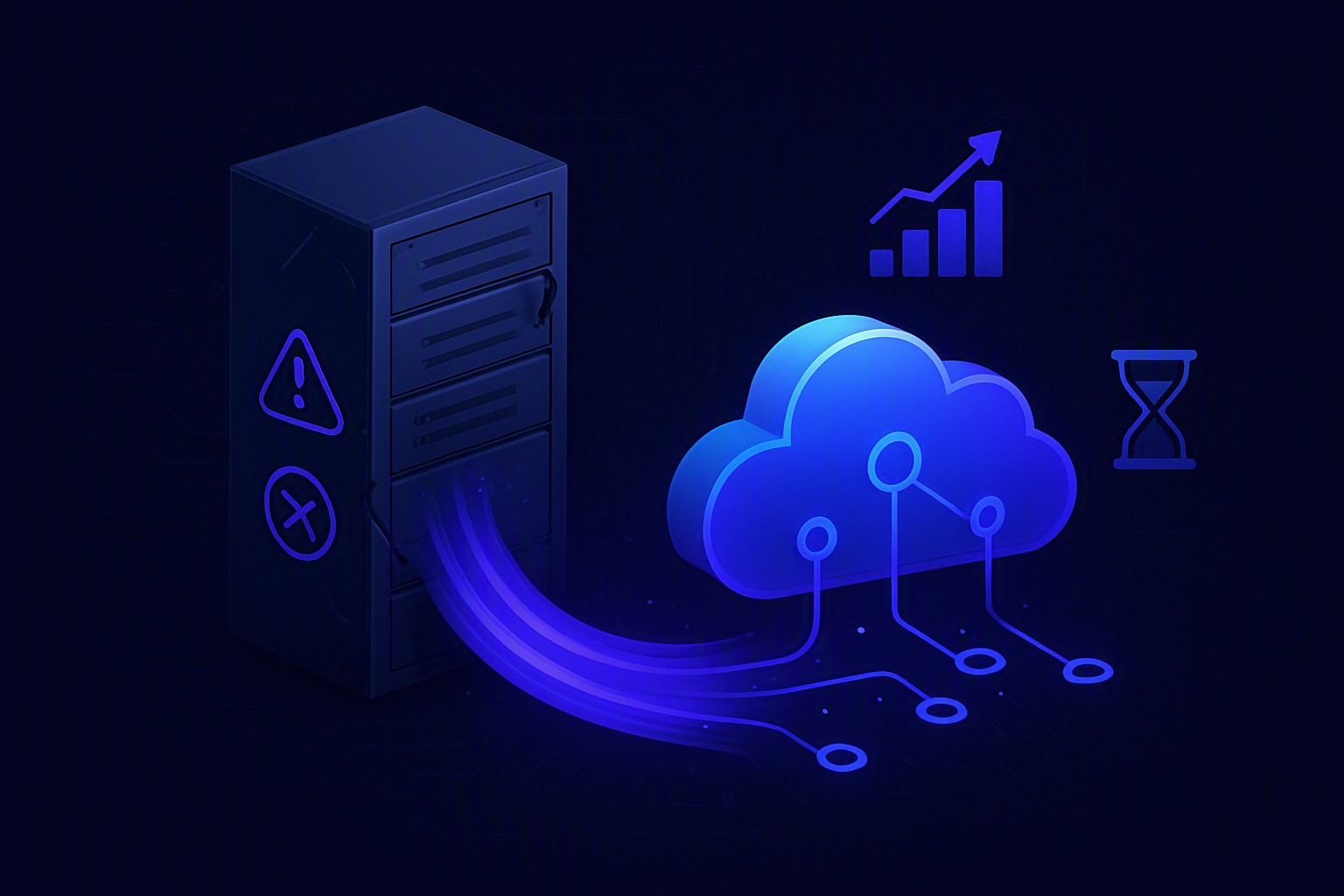
For many established enterprises, legacy systems are the digital equivalent of an aging factory: they still produce, but every day of operation quietly erodes margins, agility, and competitive position. Research consistently shows that organizations spend 60–80% of their IT budgets merely maintaining existing systems — money that generates no new capability, no new revenue, and no differentiation. Yet the true cost of inaction extends far beyond maintenance invoices. For CTOs, IT directors, and CEOs evaluating infrastructure modernization, understanding these hidden costs is the first step toward a defensible business case.
Legacy systems rarely fail suddenly. They decay gradually, and each year of deferred modernization compounds four interrelated risks.
1. Expanding security vulnerabilities.
End-of-life software no longer receives security patches, making it a primary target for attackers. Unpatched vulnerabilities in legacy stacks are among the most common entry points for ransomware and data breaches. Beyond the direct financial damage, regulatory frameworks such as GDPR and KVKK impose substantial penalties for breaches resulting from "reasonable security failures" — a category aging infrastructure increasingly falls into.
2. Performance degradation and operational drag.
Monolithic architectures built decades ago were not designed for today's transaction volumes, concurrency demands, or real-time analytics. The result is slow batch processing, frequent downtime during peak loads, and teams that spend hours working around limitations rather than creating value.
3. Integration failure with the modern API economy.
Your partners, customers, and fintech or logistics providers operate on REST, GraphQL, and event-driven APIs. Legacy systems without modern interfaces force manual data entry, fragile point-to-point connections, and CSV exports — breaking the automation chains your competitors take for granted.
4. The technical debt spiral.
Technical debt behaves like compound interest in reverse: every quick fix, undocumented workaround, and departing senior developer who "knew how the old system works" increases the eventual repayment cost. Industry analyses suggest that up to 40% of a typical technology stack's balance sheet value is consumed by technical debt — and unlike financial debt, it never gets written off. It only gets paid, with interest, or it collapses.
Before discussing solutions, it's worth making the invisible visible. The costs of a legacy estate typically include:
A useful executive exercise: multiply your maintenance spend by three. That approximation — including opportunity and risk costs — is closer to your real annual legacy tax.
There is no single correct route. The optimal strategy depends on your system's business criticality, code quality, and risk tolerance. The three dominant approaches each carry distinct trade-offs:
| Criteria | Full Rewrite (Big Bang) | Modular Microservices Migration (Strangler Fig) | Cloud Integration & Re-platforming |
|---|---|---|---|
| Approach | Rebuild the entire application from scratch | Incrementally extract services around a stable core | Lift, shift, or containerize the existing system to cloud infrastructure |
| Time to value | Long (12–36 months) | Progressive (value within 3–6 months) | Fast (2–6 months) |
| Risk level | High — big-bang cutovers frequently fail | Low — gradual, reversible per module | Low–medium — limited code change |
| Technical debt impact | Eliminates debt (if scoped correctly) | Debt is reduced service by service | Debt is preserved but easier to manage |
| Best suited for | Obsolete or poorly documented codebases | Core systems that must stay live during transition | Stable systems needing scalability and cost efficiency |
| Typical investment | Highest | Medium, distributed over time | Lowest upfront |
A pragmatic recommendation for most enterprises: avoid the big-bang rewrite unless the system is beyond repair. The strangler fig pattern — progressively replacing modules with microservices while the legacy core keeps running — delivers measurable value each quarter and keeps business risk near zero. Cloud integration, meanwhile, is not a substitute for modernization but an excellent enabler: containerization (Docker, Kubernetes) and managed services reduce operational overhead immediately and prepare the ground for deeper architectural change.
Modernization is not an IT vanity project; it is a P&L intervention. Organizations that execute well typically report:
Successful modernizations follow a disciplined sequence:
The common thread: modernization done right is incremental, evidence-based, and business-aligned — never a leap of faith.
Every quarter spent deferring modernization is a quarter your competitors spent building faster, safer, and cheaper operations. The hidden costs of legacy systems do not stay hidden forever — they surface as breaches, outages, missed launches, and lost talent.
Contact us today to commission a technical analysis of your current systems and build a modernization roadmap tailored to your business — with clear milestones, measurable ROI, and zero disruption to your live operations.

Yazılımın İşletmeler İçin Önemi Yazılım, günümüz işletmelerinin ve...
Devamını oku →

A Web Page Is Really Just Three Files Everyone getting into web development hears the same trio: HTM...
Devamını oku →