
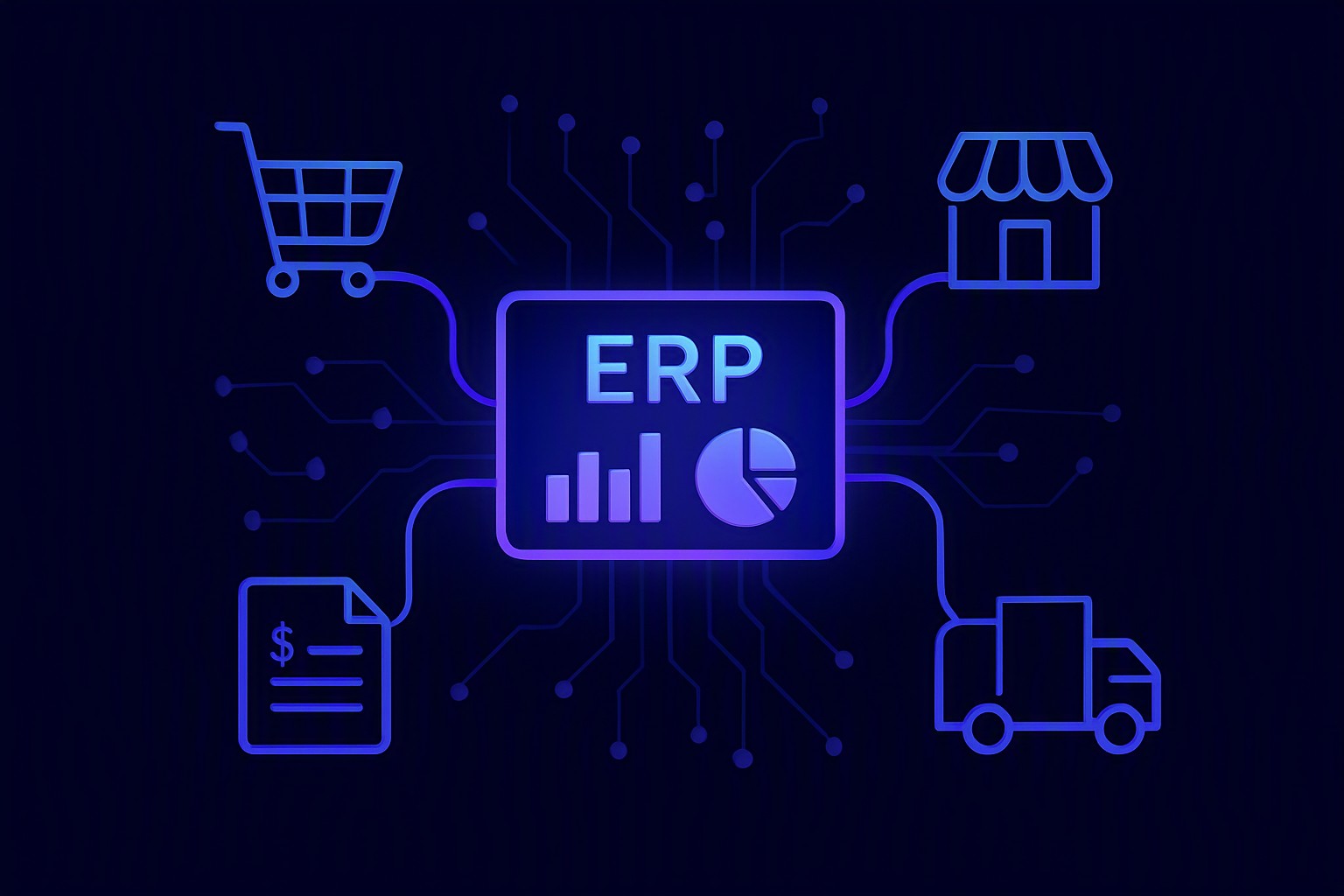
Selling across multiple channels is no longer a growth strategy — it is the baseline for survival in modern retail. A typical business today lists products on marketplaces like Amazon and Trendyol, runs its own web store, and fulfills wholesale orders simultaneously. Each channel brings its own dashboard, its own order format, and its own stock logic. When these systems do not talk to each other, the result is predictable: oversold products, delayed invoices, angry customers, and hours of manual work every single day.
This is exactly where ERP (Enterprise Resource Planning) integration stops being an IT luxury and becomes an operational necessity. In this article, we break down the real problems of multi-channel selling, what a fully integrated system solves, and why a custom-built integration often outperforms off-the-shelf connectors.
Most e-commerce teams recognize at least three of the following scenarios. If you do, your operations are leaking both revenue and reputation.
Without real-time synchronization, every sales channel manages its own stock count. Your ERP says you have 5 units, but Trendyol, Amazon, and your website each believe they have 5 as well — meaning you can sell up to 20 units of a product you do not actually own. The consequences:
When orders arrive from five different channels, someone has to log into each platform, download order data, prepare invoices, and match payments. This creates:
Returns are where disconnected systems hurt the most. A product returned on one channel needs to re-enter stock, trigger a refund, update accounting, and adjust marketplace reports. Done manually, this leads to:
Individually, these seem like small operational annoyances. Multiplied across hundreds of monthly orders, they become a structural drag on growth.
A properly designed integration connects your ERP (the operational core of your business) directly to every sales channel through APIs. Data no longer gets copied by humans — it flows automatically, in both directions. Here is what that looks like in practice:
The measurable results reported by businesses after integration typically include 70–90% less manual order processing time, near-zero overselling incidents, and dramatically faster monthly closing cycles for accounting.
Once a business decides to integrate, the next question is how. The market is full of subscription-based middleware platforms ("connectors") that promise quick setup. They work — up to a point. But for businesses with complex catalogs, custom pricing, wholesale agreements, or local regulatory needs (such as e-invoicing compliance), ready-made tools often hit a ceiling.
| Criteria | Off-the-Shelf Connector Platforms | Custom ERP Integration Software |
|---|---|---|
| Cost structure | Monthly/annual subscription fees that grow with order volume; often per-connection pricing | One-time development plus maintenance; no per-order or per-channel fees |
| Data flow | Standardized, limited to what the platform supports; sync intervals can be delayed | Fully tailored API flows; real-time or custom-defined synchronization |
| Flexibility | You adapt your workflow to the tool | The software adapts to your workflow, pricing rules, and reporting needs |
| Scalability | Adding channels or custom logic often means upgrading to higher tiers or hitting limits | New marketplaces, warehouses, or business rules can be added on demand |
| Error handling | Generic error logs; you depend on the vendor's support queue | Custom alerts, retry logic, and direct ownership of the integration |
| Regulatory fit | Local requirements (e-invoicing, accounting formats) may be partial or delayed | Built specifically for your jurisdiction and accounting setup |
For a small seller with simple needs, a connector can be a reasonable starting point. But as order volume grows, subscription costs compound — and the platform becomes both a recurring expense and a single point of failure you do not control. A custom integration converts that recurring cost into a company asset: software you own, tuned precisely to your operation, with uninterrupted data flow and no vendor lock-in.
You do not need to be an enterprise to justify integration. Use this quick checklist — if you answer "yes" to two or more, the ROI case is already strong:
A practical rollout usually follows a simple sequence: connect your ERP to your highest-volume marketplace first, validate stock synchronization, then layer in invoicing, shipping, and returns automation before extending to remaining channels. Most businesses see measurable time savings within the first month.
Multi-channel selling rewards businesses whose systems are connected — and punishes those who manage growth with spreadsheets and copy-paste. ERP integration is not about technology for its own sake; it is about protecting your seller ratings, your cash flow, and your team's time as you scale.
Ready to eliminate overselling, invoice backlogs, and returns chaos? Manage your sales channels from a single hub — explore our custom integration solutions and let your ERP do the heavy lifting while you focus on growth.


Creating a Workflow Diagram in Excel Using Add-insIn today's article, I will explain how you can cre...
Devamını oku →
Effective Software Testing Strategies for Modern Development In the rapidly evolving landscape of te...
Devamını oku →